Insights / Design
What a UX audit should tell you, and how to act on it
In short
- A useful UX audit ends in decisions, not a long list. Expect a clear score, the problems ranked by impact and effort, and a short list of fixes to ship first.
- Every finding should point to evidence, such as an annotated screen, a heuristic, a benchmark or real user behaviour.
- Audits cover more than looks. Accessibility, clarity, layout, copy and trust each change whether people finish what they came to do.
- Fix in small releases and measure each one, rather than waiting for a redesign.
- An automated review is a fast first pass. A person in the room is still needed to weigh findings against your business and your users.
Most UX audits we are asked to review share the same problem. They are long, they are thorough, and nobody acts on them. Sixty findings in a slide deck do not tell a product team what to do on Monday.
A good audit is shorter and sharper. Here is what it should give you.
A score you can track
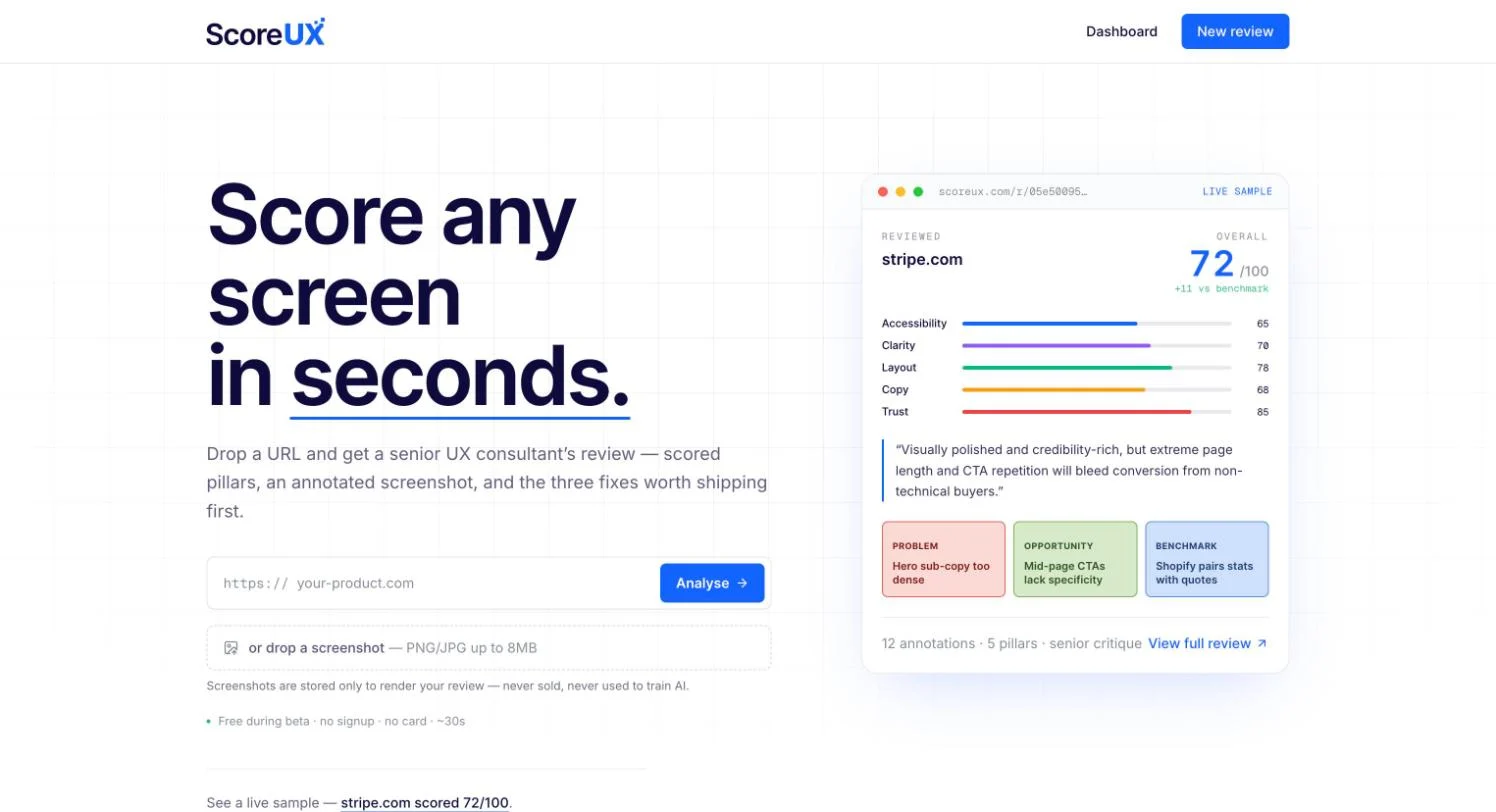
Start with a score against a clear, stated framework. We use five pillars: accessibility, clarity, layout, copy and trust. A score is not the point in itself, but it gives you a baseline and a way to show progress after each release.
The framework matters more than the number. If an audit cannot tell you how it scored something, the score is decoration.
Findings ranked by impact and effort
Every finding should answer two questions: how much does this hurt, and how hard is it to fix? Plot them and the plan writes itself.
- High impact, low effort. Ship these this sprint. Contrast fixes, clearer button labels and removing a competing call to action often sit here. These are clarity fixes, the kind retro game UI solved by showing only what the player needed.
- High impact, high effort. Plan these. They usually need design and engineering together, such as restructuring a sign-up flow.
- Low impact. Log them and move on.
Evidence for every claim
"The hero feels busy" is an opinion. "The hero subtitle runs to four lines of small text before the call to action, and the button contrast is 2.8:1 against the 4.5:1 that WCAG AA asks for" is a finding. Good audits annotate the actual screen, cite the heuristic or standard, and point to a benchmark where one helps. The same habit of naming and linking a source for every figure is what helps a page get cited by AI search engines.
Accessibility as a baseline, not an extra
Accessibility problems are usability problems for everyone: low contrast, small targets, missing labels, focus you cannot see. They are also often a legal and procurement requirement. An audit should check key screens against WCAG 2.2 AA and flag the failures plainly.
What is working
An audit that only lists problems invites a redesign that throws away the good parts. Note what is working so it survives the changes.
Turning findings into releases
The fastest teams treat an audit as a backlog, not a project.
- Ship the top three fixes in the next release.
- Measure the journey before and after: completion, drop-off and support contacts.
- Re-score the screen.
- Pull the next three.
Small, measured releases beat a big redesign for most products. They also build the evidence you need if a bigger change is justified.
Automated reviews and expert audits
We built ScoreUX because the first pass of an audit follows a repeatable framework, and that part can be fast. It reviews a screen in about thirty seconds and returns an annotated screenshot, scored pillars and the fixes to ship first. We compare it with other review tools in the best AI tools for UX design in 2026.
An automated review does not know your business, your users or your constraints. For decisions that matter, a person still needs to weigh the findings. That is what our Platform Health Check is for: a fixed-fee audit across UX, code, architecture, performance, security and delivery, from £495.
Common questions
How long does a UX audit take?
An automated review of a single screen takes seconds. A focused expert audit of a key journey usually takes a few days. A full audit of a platform, including code, architecture and accessibility, can take one to three weeks.
What should a UX audit include?
A score against a clear framework, annotated screens, findings ranked by impact and effort, accessibility issues against WCAG, and a short list of recommended first fixes.
Is a UX audit worth it before a redesign?
Yes. An audit tells you what is actually broken and what is working, so a redesign keeps the good parts and fixes the right problems.